
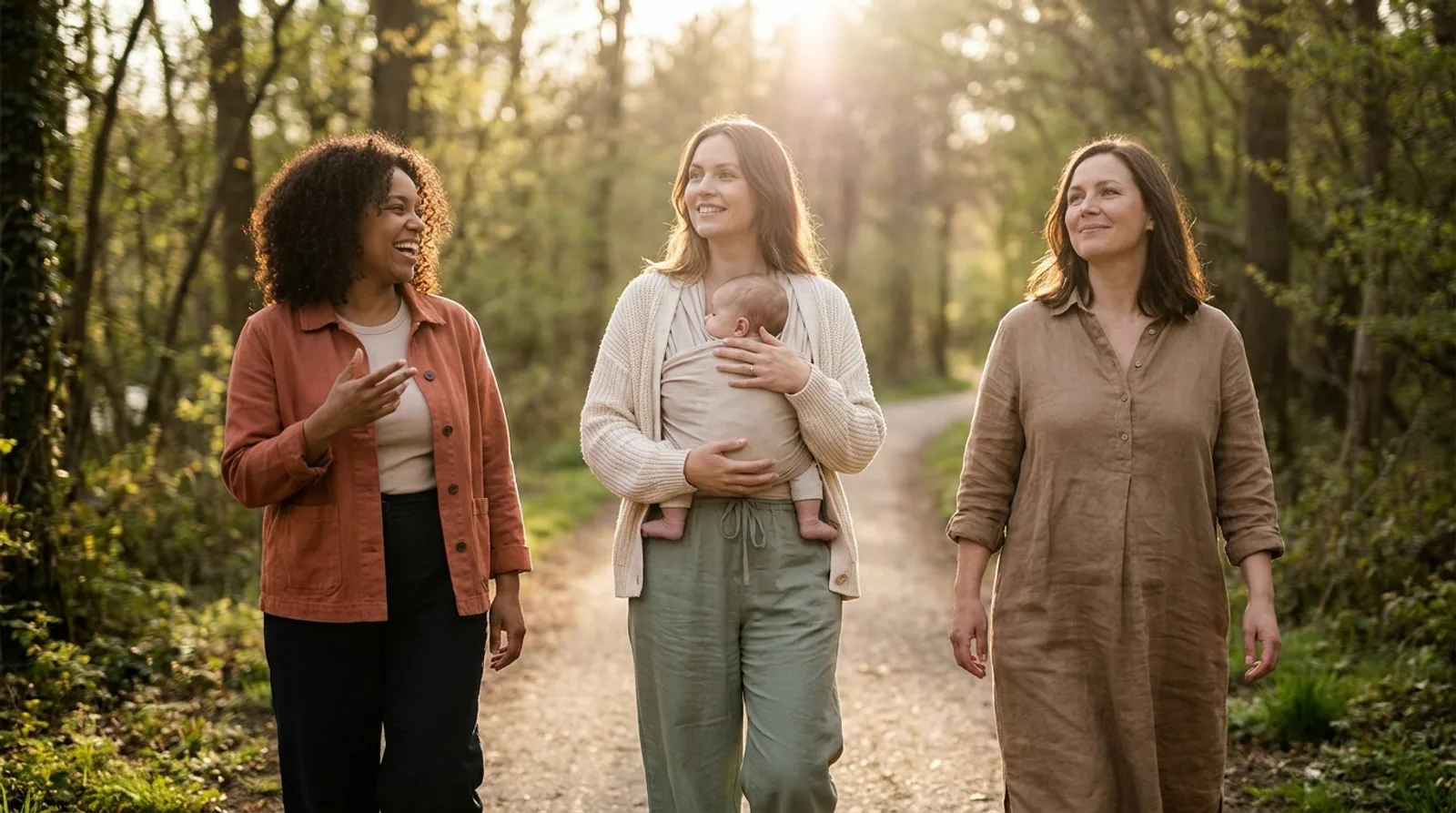
Yes, exercise is safe — and usually helpful — while trying to conceive, as long as you stay in the moderate range. Most experts point to about 150 minutes of moderate-intensity activity per week (roughly 30 minutes, 5 days), which supports more regular ovulation, better insulin sensitivity, and a calmer nervous system. The catch is at the high end: several hours of vigorous training per week can disrupt the menstrual cycle and lower your odds of conceiving. Brisk walking sits comfortably in the helpful zone, which is one reason it's the most fertility-friendly movement you can do. This is education, not medical advice — follow your provider's guidance.
Does exercise actually help you get pregnant? #
For most people, moderate exercise gently improves the odds. In a peer-reviewed mini-review, women doing about 2 hours per week of moderate activity were roughly 15% more likely to conceive than sedentary women (F&S Reports, 2023).
The benefit isn't magic — it's metabolic. Regular moderate movement improves insulin sensitivity, lowers inflammation, and supports the hormonal signaling that drives ovulation. The effect is biggest if you're starting from a sedentary baseline or carrying extra metabolic load: in people with PCOS, exercise raised ovulation rates to 65% versus 25% with diet changes alone (F&S Reports, 2023). If you've never exercised before, our guide on starting exercise during pregnancy if you were never active applies just as well to the months before conception.
How much exercise is the right amount when trying to conceive? #
Aim for the same target health bodies recommend for general health and pregnancy: at least 150 minutes of moderate-intensity aerobic activity per week, plus a couple of muscle-strengthening sessions. That's the figure ACOG and the NHS use, and the one cited in preconception-care guidance (PMC, 2025; NHS Inform).
Moderate means you're working but can still hold a conversation — the basis of the talk test. We frame it as effort, not pace: a brisk walk that leaves you breathing a little harder but still able to chat is exactly right, and you don't need a heart-rate strap to find it. If you want the full picture on the 150-minute number, see how much exercise is safe and the ACOG guideline.
| Weekly activity | Fertility signal |
|---|---|
| Sedentary (little/no movement) | Associated with lower fertility; the body's metabolic and hormonal baseline isn't supported |
| ~150 min/week moderate (e.g. brisk walking) | Sweet spot — supports ovulation, insulin sensitivity, mood; ~15% higher conception likelihood vs sedentary |
| 2 hrs/week vigorous | ~16% lower likelihood of conceiving in healthy-weight women |
| 3-4 hrs/week vigorous | ~27% lower likelihood |
| 5+ hrs/week vigorous | ~32% lower likelihood; rising risk of cycle disruption |
How much exercise is too much, and how would I know? #
Too much usually means several hours of vigorous training per week combined with not eating enough to fuel it — and the clearest warning sign is a menstrual cycle that becomes irregular or stops. In healthy-weight women, vigorous exercise shows a clear downward dose-response on conception, and about 58% of women running ~32 km/week had menstrual abnormalities, versus 9% of sedentary women (F&S Reports, 2023).
The real culprit is energy availability, not exercise itself. When you burn far more than you eat, the body slows its metabolism to conserve energy — and one of the first systems it switches off is ovulation. As Cleveland Clinic puts it, "During amenorrhea, your metabolism slows way down — so slow, you stop ovulating to conserve energy" (Cleveland Clinic). Crucially, studies suggest fueling adequately can blunt much of the fertility downside of hard training (F&S Reports, 2023). For more on this balance, see can too much exercise affect fertility and ovulation.
What are the safest, most fertility-friendly activities? #
Walking is the standout: low-impact, easy to sustain daily, and squarely in the moderate zone without the energy-deficit risk of hard training. Just 30 minutes of brisk walking five days a week lands you at the 150-minute target. Pair it with gentle strength work and you've covered the recommendation.
| Fertility-friendly | Fine in moderation — keep it gentle |
|---|---|
| Brisk walking (the easiest win) | Running / jogging — keep total vigorous time modest |
| Swimming and water aerobics | Spin / HIIT classes — limit frequency, fuel well |
| Stationary or easy outdoor cycling | Heavy CrossFit-style sessions |
| Gentle strength / resistance training | Long-distance endurance training (high weekly mileage) |
| Yoga, Pilates, mobility work | Competitive training blocks with low calorie intake |
You don't need to track pace, heart rate, or a wearable to do this well. MaMile uses perceived effort (RPE) and a short morning self-check instead — your own sense of "this is comfortably brisk" is more honest than a number on a screen, and it naturally keeps you out of the overtraining zone. For a paced, week-by-week approach, see gentle movement while trying to conceive.
Should I change anything once I might be pregnant? #
Generally no — if your activity is moderate and feels good, you can keep going into early pregnancy. Moderate exercise like walking is recommended throughout an uncomplicated pregnancy, and continuity matters more than intensity. During the two-week wait, there's no need to stop moving; see should you keep exercising during the two-week wait.
What does change is the bar for stopping and checking in. Once pregnant, learn the warning signs that mean stop and call your provider, and read how walking shifts across the three trimesters in our trimester-by-trimester walking guide. For the complete picture, start with our pillar: Pregnancy Movement: the complete guide.
Can too much exercise stop me from getting pregnant?
It can, but usually only with sustained vigorous training paired with under-eating. The warning sign is a cycle that becomes irregular or stops — a signal you're under-fueled and may not be ovulating. It's typically reversible with more rest and more food, and worth discussing with a provider.
Is walking enough exercise while trying to conceive?
Yes. About 30 minutes of brisk walking five days a week hits the recommended 150 minutes of moderate activity, supports ovulation and insulin sensitivity, and avoids the energy-deficit risks of intense training. It's the most fertility-friendly activity for most people.
How do I know if I'm exercising at the right intensity?
Use the talk test: at moderate intensity you can hold a conversation but not sing. If you can only gasp out 1-2 words, that's vigorous. You don't need a heart-rate monitor — your own sense of effort is a reliable guide.
I have PCOS — should I still exercise while trying to conceive?
Yes, and it may help more than for others. In studies, exercise raised ovulation rates in people with PCOS even without major weight loss (65% vs 25% with diet alone). Moderate activity improves insulin sensitivity, which often supports more regular ovulation. Confirm a plan with your provider.
Do I need to stop running or HIIT entirely?
Not necessarily. Vigorous exercise in moderation is fine for many people, and fueling adequately blunts much of the fertility downside. The concern is high weekly volume plus under-eating. If your cycle stays regular and you feel well, you likely don't need to quit — just don't pile on hours while skimping on food.